
You’re running a small business in Sweden. You know you need video content, but the idea of hiring a crew or buying expensive gear makes your stomach drop. Here’s the truth: you don’t need any of that. Your phone is enough. If you can send a text, you can learn how to film your small business with just a phone and start posting content that actually shows what you do.
TL;DR
- Natural Swedish light near a window beats expensive lighting kits every time
- Hold your phone horizontal, clean the lens, and get close to your subject for clear audio
- Film in short clips (15-45 seconds), edit in free apps like CapCut, and post consistently
- You don’t need to show your face; hands, products, and workspace footage works just as well
- Start today with what you have; good enough beats waiting for perfect
Use Swedish daylight as your main light source
The single biggest factor in how your video looks is light. Not your phone model, not your editing skills, not the backdrop. Light. And Sweden gives you something most countries don’t: soft, diffused light for a huge part of the year.
Here’s what you do. Find the largest window in your workspace. Between 9am and 11am, or again from 2pm to 4pm, position yourself or your product about two meters from that window. Turn so the light hits you from the side, not from directly behind or in front. Side light creates dimension and keeps your phone’s sensor from getting confused by bright backlighting.
Overcast days in Göteborg or Malmö are your friend. Clouds act like a giant softbox, spreading light evenly without harsh shadows. Your phone’s camera handles this kind of light beautifully because there are no extreme brights or darks to balance. If it’s a rare sunny day, film in the morning or late afternoon when the sun is lower and softer, or move slightly away from the window so you’re not squinting.
Winter is darker, yes. But Swedish winter light between 10am and 2pm is low, golden, and forgiving. If you’re filming after dark, one small LED panel light from Kjell & Company for about 400 kronor will do the job. Point it at a white wall and let it bounce back onto you. Bounced light is softer and more flattering than aiming a light straight at your face.
Why window light works better than overhead lights
Overhead ceiling lights in Swedish apartments and shops create shadows under your eyes and nose. They’re also often yellow or cool white, and your phone will struggle to white-balance them, making your footage look sickly. Window light is full-spectrum and natural. Your phone’s camera is designed to handle it. Use it.
How to film your small business with just a phone by holding it correctly
This sounds basic, but most shaky, unusable footage comes from how people hold their phones. If you’re hand-holding, brace your elbows tight against your ribs. Hold your breath for short clips. This gives you a stable platform. Your arms floating in the air will shake, no matter how steady you think you are.
For anything longer than 10 seconds, prop your phone against something. A coffee mug. A stack of books. The corner of a shelf. I’ve filmed entire product walkthroughs with my phone leaning against a Malmö cityguide book on a table. It worked. No one watching your video cares how you stabilized it; they just don’t want motion sickness.
If you’re filming yourself talking, buy a cheap phone holder that clamps to a table or a small flexible tripod. These cost around 150 kronor and free up your hands so you can gesture, hold a product, or just relax. You’ll look more natural because you’re not thinking about keeping the phone still.
Walk slowly if you’re filming a moving shot. Bend your knees slightly and glide, don’t bounce. Think of yourself as a Steadicam. It sounds silly, but it works. Film a test lap around your shop or studio, watch it back, and you’ll see what I mean.
Horizontal or vertical?
Shoot horizontal for YouTube, your website, and LinkedIn. Shoot vertical for Instagram Reels and Stories. If you’re not sure where you’ll post it, go horizontal. You can always crop a horizontal video to vertical in CapCut later, but you can’t add width to a vertical clip. Horizontal also looks more professional and works better if someone watches on a laptop.
Get close for clear audio
Your phone’s microphone is small and picks up everything within three meters. That’s good and bad. Good because you don’t need an external mic if you’re close. Bad because it’ll also record the fridge humming, traffic outside, and your neighbor’s dog.
Film in the quietest room you have. Close the door. Turn off fans and music. Stand within one meter of your phone when you’re talking. The closer you are, the louder your voice is relative to background noise, and that’s what makes audio sound clean.
If you’re filming a product and adding voiceover later, record the voiceover separately in a quiet space with your phone 20 centimeters from your mouth. You can use the voice memo app, then drop that audio into CapCut over your silent footage. This gives you much better sound than trying to talk while filming from across the room.
For about 200 kronor, you can buy a clip-on lavalier mic that plugs into your phone’s headphone jack or Lightning port. It’s not essential, but it cuts background noise in half and makes your voice sound fuller. I use one when I’m filming client work in noisy Stockholm cafés. It’s a small upgrade that makes a real difference.
Test your audio before you film the real take
Record five seconds of yourself talking. Play it back with headphones. If you can hear yourself clearly without straining, you’re good. If it sounds muffled or distant, move the phone closer. If you hear echo, you’re in a room with hard surfaces; hang a blanket on a chair behind the phone to absorb some bounce.
Frame your shots using the rule of thirds
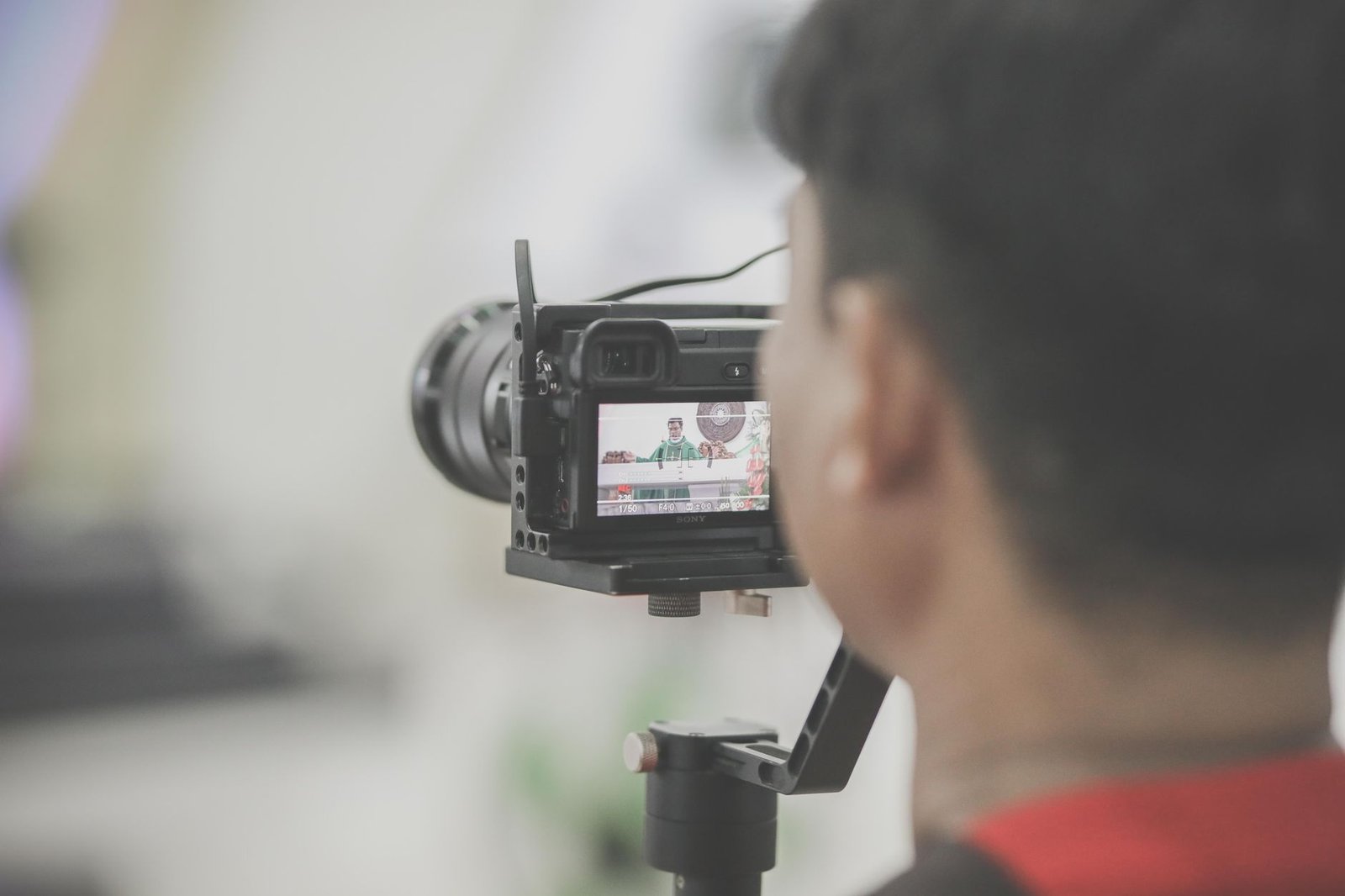
Open your phone’s camera settings and turn on the grid. You’ll see two horizontal lines and two vertical lines dividing the screen into nine boxes. This is the rule of thirds, and it’s the easiest way to make your videos look intentional instead of random.
When you’re filming yourself, position your eyes along the top horizontal line. Leave a little space above your head (called headroom), but not too much. If you’re filming a product, place it where the lines intersect. These intersection points are where the viewer’s eye naturally goes.
Don’t center everything. Centered shots look stiff and amateur unless you’re doing it on purpose for symmetry. Offset your subject slightly to the left or right. If you’re talking to the camera and looking slightly off to one side, position yourself on the opposite side of the frame so there’s space in the direction you’re looking. It sounds fussy, but your eye will know when it looks right.
When filming products for a Swedish online shop, shoot at the product’s eye level, not from above unless you’re doing a flat-lay. Eye level makes the product feel real and tangible. Overhead shots work for things like jewelry, pastries, or anything flat, but a candle or a bottle looks better when you’re level with it.
How much background should you show?
Enough to give context, not so much that it distracts. If you’re in a clean Scandinavian-style studio, show it. If your workspace is cluttered, shoot tighter so the background blurs out. Your phone’s portrait mode can help here; it keeps your face or product sharp and softens everything behind it. Just don’t overdo the blur or it looks fake.
Edit in CapCut and keep it simple
You’ve filmed your clips. Now you need to edit. Download CapCut. It’s free, works on iPhone and Android, and doesn’t watermark your exports. The interface is intuitive enough that you’ll figure it out in 10 minutes.
Import your clips. Trim the beginning and end where you’re fumbling with the phone or walking into frame. Cut out long pauses, mistakes, and “um”s. Keep only the good parts. A tight 20-second video beats a meandering 90-second one.
Add text overlays if you’re posting to Instagram or LinkedIn. Use CapCut’s auto-caption feature if you’re speaking; it transcribes Swedish fairly well, though you’ll need to fix a few words. Put captions at the bottom third of the frame so they don’t cover faces. Use white text with a black outline so it reads over any background.
Adjust brightness and contrast if your footage looks a little flat. CapCut has a one-tap “auto-adjust” that works well enough. Don’t go overboard with filters; they date your content and often make skin tones look weird. Natural is better.
Export at 1080p, 30fps. That’s the sweet spot for file size and quality. Your phone and CapCut can handle it without lag, and it looks sharp on every platform.
Templates save time
CapCut has templates where you drop in your clips and it auto-edits to music. These are great when you’re starting out or in a hurry. Pick a template that matches your vibe (calm, energetic, minimal), load your clips, tweak the text, and export. You’ll have a finished video in five minutes.
Batch-film when the light is good
You won’t want to set up your phone, find good light, and film every single day. So don’t. Pick one morning when the light is right, your space is tidy, and you have an hour. Film three or four short clips in one session.
Introduce yourself and your business. Show a product. Film your hands doing the work. Record a 10-second pan of your workspace. These clips give you enough material to post twice a week for two weeks. Edit them in batches, schedule them, and you’re done.
This approach is how small businesses in Sweden actually keep up with content. You’re not a full-time creator; you’re running a business. Batching respects that. It also means you’re not scrambling every Monday morning trying to film something before you open.
Write down three or four simple ideas before you start filming. Not scripts, just bullet points. “Show how I pack an order.” “Explain why I use this material.” “Quick tour of the studio.” One idea per video. Knowing what you’re filming before you press record makes the whole process faster and less stressful.
Use your phone’s native camera app
You don’t need a fancy third-party camera app. Your phone’s built-in camera is optimized for its sensor and processor. Shoot in 1080p at 30fps for most things. If your phone offers 4K, it’s overkill for social media and eats up storage. Stick with 1080p unless you’re filming something you’ll use on a big screen later.
Start with what you have, right now
The best camera is the one in your pocket. You don’t need a newer phone, a gimbal, a microphone, or a ring light to start. You need window light, a quiet room, and the willingness to press record. Everything else is extra.
I’ve seen beautiful, effective business videos shot on five-year-old iPhones in cramped Uppsala apartments. I’ve also seen terrible videos shot on expensive cameras with perfect lighting, because the person filming didn’t know what they were trying to say. The tool matters less than the intention.
Your first video will feel awkward. You’ll watch it back and cringe a little. That’s normal. Everyone’s first video is rough. But your tenth video will be noticeably better, and your fiftieth will look professional. The only way to get there is to start. Film something today. A 15-second clip of your product. A short introduction. Anything. Edit it in CapCut, post it, and move on.
People want to see the real work you do, not a polished ad. They want to know who’s behind the business, what your space looks like, how you make or source your products. Filming with your phone gives you that raw, honest quality that actually builds trust. Expensive production can make you look distant and corporate. A phone video makes you look human.
You don’t need to show your face
If you’re camera-shy, film your hands working. Film the product from different angles. Film your workspace, your tools, the materials you use. Add a voiceover explaining what you’re doing. Some of the most engaging small-business content in Sweden never shows the owner’s face. It works because it focuses on the craft, not the personality.
Key takeaways
- Natural light from a window is your best tool; film between 9am and 4pm in Sweden for soft, even light.
- Hold your phone horizontal, brace your elbows, and prop it against something solid for stable footage.
- Get within one meter of your phone for clear audio, or use a cheap 200-kronor clip-on mic.
- Batch-film three or four clips in one session, edit them in CapCut, and post twice a week.
- Start today with the phone you already own; good enough beats waiting for perfect gear.
Learning how to film your small business with just a phone isn’t about mastering advanced techniques or buying gear. It’s about using the tools you already have, working with Swedish light and small spaces, and posting consistently. Every video you make will be better than the last. The hardest part is pressing record the first time. After that, it’s just repetition.
If you get stuck or want a second pair of eyes on your footage, send me a message. I’m happy to take a quick look and give you one specific thing to improve. No sales pitch, just one small creator helping another.
Frequently Asked Questions
How do I start filming my small business with just a phone?
Start by turning your phone horizontal and cleaning the lens with your shirt. Find a window with natural light, position yourself or your product two meters away, and tap the screen to focus. Record a 15-second clip describing what you do. That's it. You've started.
What phone settings should I use for business videos?
Open your camera app and switch to video mode at 1080p and 30fps. Turn on the grid in settings to help you frame shots using the rule of thirds. Lock exposure by tapping and holding on your subject until you see AE/AF Lock. Don't use digital zoom; it makes footage grainy.
Do I need a tripod to film my small business?
Not at first. Prop your phone against a coffee mug, a stack of books, or lean it in the corner of a shelf. A cheap phone holder that clamps to a table costs about 150 kronor at Kjell & Company in Sweden and works better than hand-holding for static shots.
What's the best time of day to film with a phone in Sweden?
Between 9am and 11am, or 2pm and 4pm. Swedish winter light is soft and low all day, which is actually good for phones because harsh sun creates shadows your camera can't handle. Overcast days in Göteborg or Malmö give you even, flattering light without hotspots.
How do I get good sound when filming with my phone?
Get close. Phone mics pick up everything, so film in a quiet room and stand within one meter of your subject. A clip-on lavalier mic that plugs into your phone costs around 200 kronor and cuts background noise by half. Record a test clip and listen with headphones before you film the real take.
Should I film vertically or horizontally for my business?
Horizontal for YouTube, your website, and LinkedIn. Vertical for Instagram Reels and Stories. If you're filming product demos or walkthroughs, shoot horizontal; you can always crop to vertical later in CapCut, but you can't add width to a vertical clip.
How long should my small business videos be?
15 to 45 seconds for social media. 60 to 90 seconds for a service explainer on your website. People scroll fast. Get to the point in the first three seconds or they'll swipe. One idea per video works better than cramming five messages into two minutes.
What should I film first for my small business?
Film yourself introducing your business in one sentence, then show your product or workspace. Next, film a short clip of you doing the work: packing an order, consulting a client, making a coffee. These three clips give you enough material for a week of posts.
How do I keep my phone steady while filming?
Brace your elbows against your ribs and hold your breath for short clips. For longer takes, lean your shoulder against a wall or doorframe. Walk slowly with bent knees if you're filming a moving shot. Smooth is more important than perfectly still.
Can I film in my small Stockholm apartment or shop?
Yes. Push furniture back to create two meters of space. Film near the window and angle your phone so the light hits your face or product from the side, not from behind. Small spaces look bigger on camera when you shoot from a corner at a slight angle instead of straight-on.
What free apps can I use to edit phone videos?
CapCut is free, works on iPhone and Android, and has templates that do most of the work for you. Trim clips, add text overlays, and adjust brightness without a learning curve. Export at 1080p. If you need something simpler, use the built-in editor in your phone's Photos app to trim and adjust exposure.
How do I make my phone videos look professional?
Clean your lens, use natural light, and hold the phone still. That's 80% of it. The other 20% is framing: leave a little headroom above your subject, don't center everything, and cut out the first two seconds where you're fumbling to press record.
Should I script my small business videos?
Write three bullet points, not a script. Know your opening line, your main point, and your closing sentence. Speaking naturally to the camera beats reading stiffly from a script. If you mess up, pause for two seconds and start the sentence again; you'll cut the mistake out in editing.
How often should I post videos of my small business?
Once or twice a week is realistic if you're doing everything yourself. Batch-film three or four clips in one session when the light is good, then edit and post them over the next two weeks. Consistency beats frequency.
Do I need to show my face in business videos?
No. Plenty of small businesses in Sweden film only their hands working, their products, or their workspace. Overhead shots of you packing orders or arranging flowers work well. If you're uncomfortable on camera, start with voiceover clips showing what you make or do.
How do I deal with Swedish winter darkness when filming?
Film near a window during the few daylight hours, or buy a small LED panel light for about 400 kronor. Position it at 45 degrees to your face, bounce it off a white wall to soften it. Swedish winters are dark, but your phone's sensor can handle low light better than you think if you add one small light source.
What's the biggest mistake people make filming with a phone?
Filming in bad light and trying to fix it later. Your phone can't recover detail from dark, muddy footage. Always start with good light. The second mistake is filming too much; a tight 20-second clip beats a wandering two-minute ramble.
How do I film products for my Swedish online shop?
Put the product on a plain surface near a window. Use a white poster board from Panduro as a backdrop. Film at eye level with the product, not from above unless you're shooting flat-lays. Rotate the product slowly, or keep it still and move your phone in a smooth arc. Three to five seconds per angle is enough.
Can I use my old phone to film if I have a newer one?
Yes. Use the newer phone as your main camera and the old one as a second angle, or prop the old one up to record backup audio. Even a five-year-old iPhone shoots usable 1080p video in good light. Clean the lens and turn off any cracked-screen overlays in accessibility settings.
How do I add text or captions to my phone videos?
Use CapCut's auto-caption feature; it transcribes Swedish speech with decent accuracy. Edit any mistakes by tapping the text. Keep captions at the bottom third of the frame so they don't cover faces or products. Use white text with a black outline so it reads clearly over any background.
Should I film myself talking or add voiceover later?
If you're comfortable on camera, film yourself talking; it's faster and feels more personal. If not, film silent B-roll of your work and record voiceover separately in a quiet room with your phone close to your mouth. Both work. Pick the one you'll actually finish.
How much does it cost to start filming my small business with a phone?
Zero, if you already own a smartphone. A basic clip-on mic costs around 200 kronor, a small phone tripod is 150 kronor, and CapCut is free. You can film, edit, and post professional-looking videos for under 400 kronor total, or nothing if you skip the accessories at first.
What background should I use when filming in my Swedish home or shop?
A plain wall, a tidy shelf, or a corner with a plant. Avoid busy wallpaper or clutter that distracts from you or your product. Swedish interiors are naturally minimal, which is perfect for video. If your space is messy, shoot tight close-ups so the background blurs out.
How do I know if my phone video is good enough to post?
Watch it with the sound on. If you can hear your voice clearly, see your product or face in focus, and the clip says one clear thing in under 30 seconds, post it. Good enough beats perfect. You'll get better with every video you publish, but only if you start publishing.
Can I film outside in Swedish weather?
Yes, but avoid rain; water spots on the lens ruin footage. Overcast days in Uppsala or Lund give you beautiful, even light with no harsh shadows. Wind is your enemy; it makes audio unusable. Film outside in calm weather and keep your phone in your pocket between takes to avoid condensation on the lens when it's cold.